

The trust funnel that turns LinkedIn posts into real sales conversations
Most people think their LinkedIn problem is reach.
They post every day. They write hooks. They create carousels. They talk about personal branding, AI, business, freelancing, and growth. Some posts even get likes, comments, and impressions.
But after all that work, the real problem stays the same.
No serious leads.
No quality DMs.
No sales calls.
No clients.
That means the problem is not always visibility.
The real problem is conversion.
In 2026, LinkedIn content is not just about going viral. LinkedIn has publicly shared that it is improving the feed to reduce repetitive, click-driven posts and make content feel more authentic and professionally relevant.
So if your content is getting views but not clients, the issue is usually simple:
Your content is creating attention, but it is not creating enough trust.
That is the difference between a LinkedIn creator and a LinkedIn creator who gets clients.
At AjlalHaider.com, my work focuses on LinkedIn branding, profile optimization, YouTube content repurposing, and content systems for coaches, consultants, founders, creators, and B2B brands who want content that builds authority and creates business opportunities.
This blog breaks down the exact LinkedIn content strategy you need in 2026 if you want your posts to turn into profile visits, DMs, sales conversations, and clients.
The mistake most LinkedIn creators make
Most creators build content like this:
Post → Views → Hope someone buys
That is not a strategy.
That is gambling.
A real LinkedIn client acquisition system looks like this:
Post → Attention → Trust → Profile Visit → Clear Offer → DM → Sales Conversation → Client
Most people only work on the first step.
They ask:
How do I get more impressions?
How do I make my post go viral?
What hook should I use?
How do I beat the LinkedIn algorithm?
These questions matter, but they are not enough.
A post with 100,000 views can bring zero clients if it attracts the wrong audience.
A post with 5,000 views can bring a client if it speaks directly to the right buyer, proves your thinking, and sends people to a strong profile.
That is why the goal is not more content.
The goal is a better trust funnel.
What changed on LinkedIn in 2026
LinkedIn is becoming more serious about relevance, expertise, and professional value.
LinkedIn’s own algorithm guidance says creators should focus their profile, use clear keywords in the headline, skills, and about section, and keep their content connected to clear expertise so LinkedIn can better understand what they are known for.
This means LinkedIn is not only looking at one post.
It is looking at the full pattern.
Your headline.
Your about section.
Your skills.
Your comments.
Your content topics.
Your professional category.
Your audience behavior.
So when a creator posts about LinkedIn tips one day, AI tools the next day, random motivation the next day, and personal stories with no connection to their offer the next day, both LinkedIn and the audience get confused.
Confused positioning creates weak reach.
But more importantly, it creates weak buyer trust.
The people who win on LinkedIn in 2026 will not be the people who post the most.
They will be the people who become known for one clear outcome.
For me, that outcome is simple:
I help coaches, consultants, founders, and B2B creators turn LinkedIn and YouTube into client-generating content systems.
That is the level of clarity every serious creator needs.
Why views do not automatically become clients
Views only mean people saw your content.
They do not mean people understood your offer.
They do not mean people trust your expertise.
They do not mean people believe you can solve their problem.
They do not mean people are ready to pay you.
This is where many freelancers, video editors, content creators, LinkedIn branding experts, and social media managers lose opportunities with USA and international clients.
They post content that proves they can create.
But they do not post content that proves they can solve business problems.
There is a big difference.
A video editor says:
“I make reels, shorts, thumbnails, and carousels.”
A strategic content partner says:
“I help founders turn long-form YouTube and LinkedIn content into a repeatable authority system that brings profile visits, inbound DMs, and sales conversations.”
One sells tasks.
The other sells outcomes.
USA founders, coaches, consultants, and B2B brands do not only want content.
They want authority.
They want trust.
They want leads.
They want conversations.
They want a content system that makes their expertise easier to discover.
Your LinkedIn content must show that you understand that.
The LinkedIn Trust Funnel for 2026
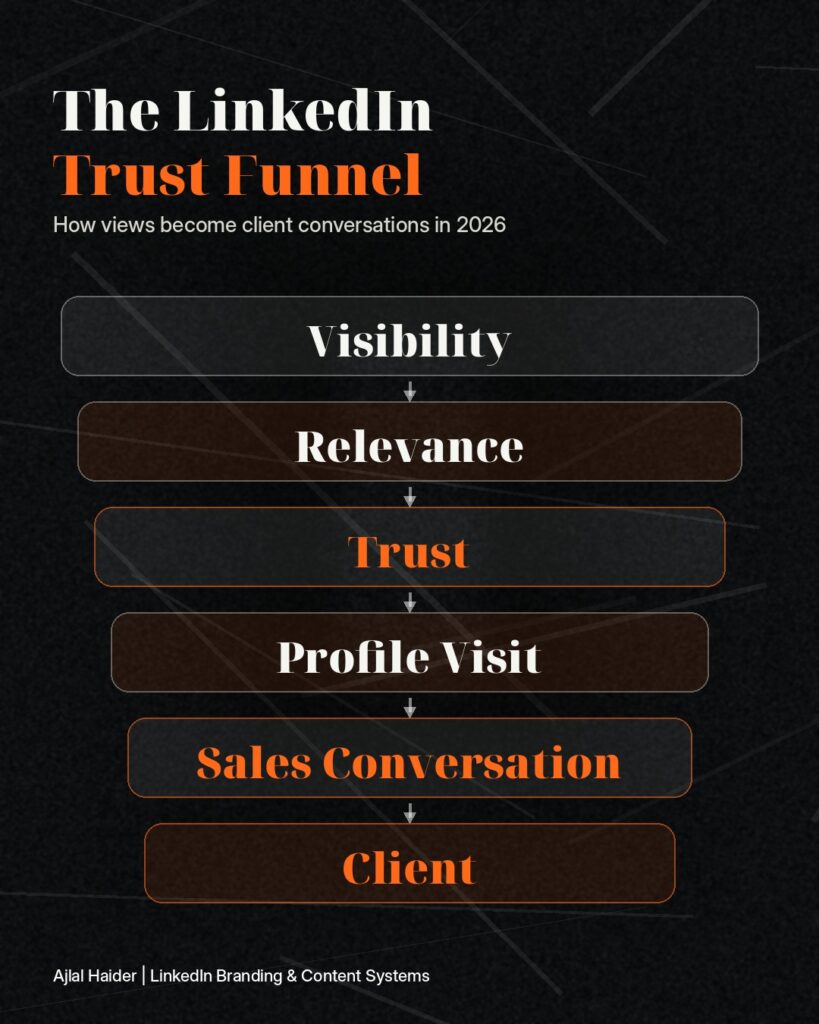
A strong LinkedIn content system has six stages.
1. Visibility
This is where people first discover your post.
Visibility comes from strong hooks, relevant topics, clean formatting, smart comments, saves, shares, and consistency.
But visibility alone is not the goal.
A viral post that attracts students, other freelancers, or random creators may look successful, but if your buyer is a coach, consultant, founder, or B2B brand, that reach may not convert.
Your content must be written for buyers, not just for creators.
2. Relevance
This is the moment where the right person thinks:
“This is exactly my problem.”
Relevance is stronger than virality.
A coach struggling to get leads does not care about generic LinkedIn tips.
But they will care about a post like:
“Why coaches get likes on LinkedIn but no consultation calls.”
A founder does not care about “how to post daily.”
But they will care about:
“How one founder can turn a weekly YouTube video into 10 LinkedIn assets without sounding repetitive.”
That is buyer relevance.
3. Trust
Trust is built through proof.
Not just claims.
Not just tips.
Not just motivational posts.
Proof can be:
Before and after profile audits
Content breakdowns
Case studies
Client lessons
Screenshots with context
Process explanations
Mistakes you fixed
Results from your own content
Strong opinions based on real experience
Google also recommends creating helpful, reliable, people-first content instead of content made only to manipulate rankings. That same principle applies to LinkedIn. People trust content that feels useful, specific, and based on real experience.
4. Profile Visit
When someone trusts a post, the next step is usually your profile.
This is where many creators lose the lead.
Their post is strong, but their profile is weak.
The buyer clicks and sees:
A vague headline
No clear offer
No proof
No niche
No outcome
No featured section
No reason to DM
That kills conversion.
Your LinkedIn profile should answer these questions in 10 seconds:
Who do you help?
What problem do you solve?
What result do you create?
Why should someone trust you?
What should they do next?
LinkedIn also says the About section should express your mission, motivation, and skills to people who view your profile.
Your profile is not just a résumé.
It is your landing page.
5. Conversation
The final goal is not likes.
The final goal is a real conversation.
That can happen through:
A DM
A comment
A booked call
A website visit
A referral
A reply to your newsletter
A response to your lead magnet
But the conversation only happens when your CTA is clear.
A weak CTA says:
“Thoughts?”
A stronger CTA says:
“If your LinkedIn content is getting views but not clients, send me ‘AUDIT’ and I’ll share what I’d fix first.”
That CTA creates action.
6. Client
The client does not come from one random viral post.
The client comes from repeated trust.
They see your posts.
They check your profile.
They understand your offer.
They see your proof.
They start believing you understand their problem.
Then they message you.
That is how LinkedIn becomes a business channel.
The five reasons your LinkedIn content is not converting
1. Your content is too broad
Broad content gets broad attention.
But broad attention rarely becomes high-quality clients.
If you talk to everyone, nobody feels like the post was written for them.
Instead of writing:
“5 tips to grow on LinkedIn”
Write:
“5 LinkedIn mistakes coaches make that stop profile visitors from booking a consultation.”
That is specific.
That attracts a buyer.
2. You educate but never diagnose
Educational content is useful, but too much education can turn you into a free teacher.
You also need diagnostic content.
Diagnostic content helps the reader understand what is broken.
Example:
“Your LinkedIn content is not failing because your hooks are weak. It is failing because your profile, posts, and offer are saying three different things.”
That makes people think.
That creates demand.
3. You post tips but no proof
Tips are everywhere.
Proof is rare.
The market does not need another creator saying:
“Be consistent.”
The market needs someone who can show:
What consistency looks like
What changed after fixing a profile
Why one post converted and another did not
How a content system is built
How a YouTube video becomes LinkedIn authority content
How a weak CTA becomes a sales conversation
Proof makes your expertise believable.
4. Your profile does not match your content
If your posts are about LinkedIn strategy but your profile says:
“Graphic Designer | Video Editor | Social Media Manager | Content Creator | YouTube Manager”
The buyer does not know what to hire you for.
This is common among skilled freelancers.
They have many abilities, but no clear market position.
Your profile should not look like a service menu.
It should look like a clear solution.
For example:
“I help coaches, consultants, and founders turn LinkedIn and YouTube into client-generating content systems.”
That is stronger because it tells the buyer what outcome you create.
5. You are not building search authority
LinkedIn is not only a social platform.
It is also a discovery engine.
Google is also a discovery engine.
Medium is also a discovery engine.
Your website should be the main authority hub.
Your LinkedIn should distribute your ideas.
Your Medium should republish or adapt your best articles.
Your LinkedIn posts should send people back to your expertise.
Your profile should send people to your website.
Your website should prove your authority.
That is how you build a digital footprint that can rank in Pakistan, the USA, and international searches.
The content system that brings clients from LinkedIn
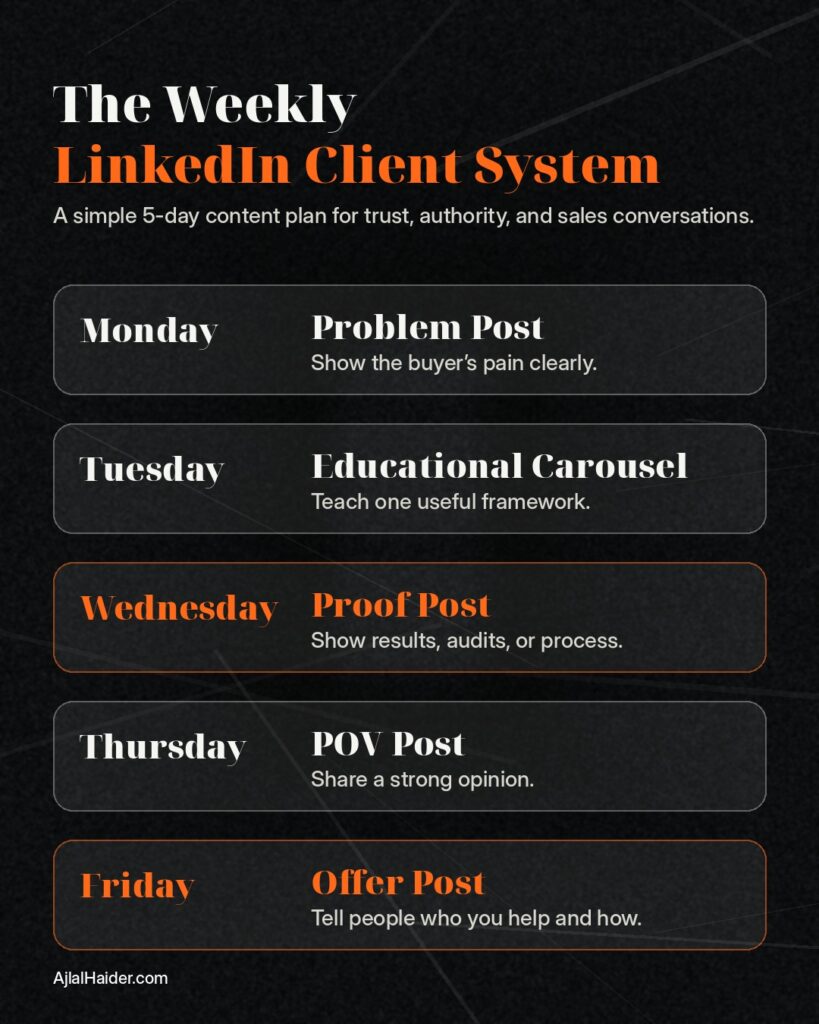
Here is the weekly system I recommend for coaches, consultants, founders, creators, and freelancers who want clients from LinkedIn.
Monday: Problem Post
Talk about the buyer’s pain.
Example:
“Your LinkedIn posts are getting engagement from other creators, but not from buyers. That is a positioning problem.”
Goal: Make the buyer feel understood.
Tuesday: Educational Carousel
Teach one useful framework.
Example:
“The LinkedIn Trust Funnel: Visibility, Relevance, Trust, Profile Visit, Sales Conversation, Client.”
Goal: Make the idea saveable and shareable.
Wednesday: Proof Post
Show evidence.
Example:
“Here is how I would fix this founder’s LinkedIn profile to make the offer clearer.”
Goal: Build trust.
Thursday: Point-of-View Post
Share a strong opinion.
Example:
“Most freelancers do not need more skills. They need a sharper category.”
Goal: Build authority.
Friday: Offer Post
Clearly say who you help and what problem you solve.
Example:
“I help coaches, consultants, and founders turn LinkedIn and YouTube into content systems that create authority, profile visits, and sales conversations.”
Goal: Create inbound leads.
This is not random posting.
This is a weekly trust-building system.
A simple example of client-focused LinkedIn content
Weak version:
“Post consistently on LinkedIn if you want clients.”
Better version:
“Posting daily will not bring clients if your content is only getting attention from people who will never buy from you.
The real system is:
- Write about a problem your buyer already feels
- Show why the problem exists
- Prove you understand the solution
- Make your profile explain the offer clearly
- Give people a simple next step
Views are not the business model.
Trust is.”
This works because it is specific, useful, and tied to a business outcome.
That is the type of content that positions you as a serious LinkedIn strategist, not just another creator posting tips.
Why LinkedIn creators need a website in 2026
LinkedIn gives you distribution.
But your website gives you ownership.
A strong website helps you:
Rank on Google
Show proof
Build authority
Host case studies
Explain services
Capture leads
Look more serious to international clients
Support AI search visibility
Build long-term trust beyond one platform
This is why your website and LinkedIn should support each other.
Your LinkedIn builds attention.
Your website builds authority.
Your Medium builds extra reach.
Your content system connects all three.
90-day LinkedIn client acquisition plan
If you are serious about getting clients from LinkedIn, follow this for 90 days.
Days 1 to 15: Fix positioning
Update your headline.
Rewrite your about section.
Add a clear featured section.
Pin your best proof.
Make your offer obvious.
Choose three content pillars only.
For Ajlal Haider, the strongest pillars should be:
LinkedIn authority systems
YouTube to LinkedIn repurposing
Profile optimization for client acquisition
Days 16 to 45: Publish trust-building content
Post five times per week.
Use this mix:
Two problem posts
One educational carousel
One proof post
One offer or story post
Do not chase random viral content.
Build recognition around your category.
Days 46 to 75: Add proof and lead magnets
Create one free audit checklist.
Create one profile optimization guide.
Create one YouTube-to-LinkedIn repurposing framework.
Use simple CTAs like:
Comment “AUDIT”
DM “PROFILE”
Message me “SYSTEM”
This creates conversations.
Days 76 to 90: Turn content into sales assets
Take your best posts and turn them into:
Website blogs
Medium articles
LinkedIn newsletter posts
Carousel PDFs
Case study pages
Email nurture content
This is how one idea becomes a complete content engine.
Final thought
Your LinkedIn content does not need more random views.
It needs a clearer strategy.
In 2026, the creators who win will be the ones who are known for a specific outcome, trusted for their experience, and easy to hire.
If your content gets views but no clients, do not only fix your hooks.
Fix your positioning.
Fix your profile.
Fix your proof.
Fix your CTA.
Fix the full trust funnel.
That is how LinkedIn becomes more than a posting platform.
That is how it becomes a client acquisition system.
About Ajlal Haider
Ajlal Haider is a Pakistan-based LinkedIn branding expert, YouTube growth strategist, video editor, and content systems specialist. Through AjlalHaider.com, he helps coaches, consultants, founders, creators, and B2B brands build authority with LinkedIn profile optimization, YouTube content repurposing, editorial video systems, and client-focused content strategy.
If your LinkedIn content is getting views but not clients, visit AjlalHaider.com and request a LinkedIn profile and content audit.
FAQ Section For SEO
Why is my LinkedIn content getting views but no clients?
Your content may be attracting attention, but not enough buyer trust. To get clients, your posts need to speak to a specific audience, show proof, connect to a clear offer, and send people to a strong LinkedIn profile.
How do I get clients from LinkedIn in 2026?
To get clients from LinkedIn in 2026, build a trust funnel. Create content around buyer problems, show proof, optimize your profile, use clear CTAs, and start real conversations with people who match your ideal client profile.
Is LinkedIn good for freelancers in Pakistan?
Yes, LinkedIn is one of the strongest platforms for Pakistani freelancers who want international clients. But freelancers need to move beyond task-based positioning and show business outcomes such as authority building, content systems, retention, and lead generation.
What should coaches and consultants post on LinkedIn?
Coaches and consultants should post problem-based content, proof posts, client lessons, frameworks, strong opinions, and clear offer posts. The goal is not just engagement. The goal is to show expertise and create sales conversations.
How can a LinkedIn profile help me get clients?
Your LinkedIn profile works like a landing page. When someone likes your post and visits your profile, your headline, banner, about section, featured section, and CTA should quickly explain who you help, what problem you solve, and why they should trust you.