
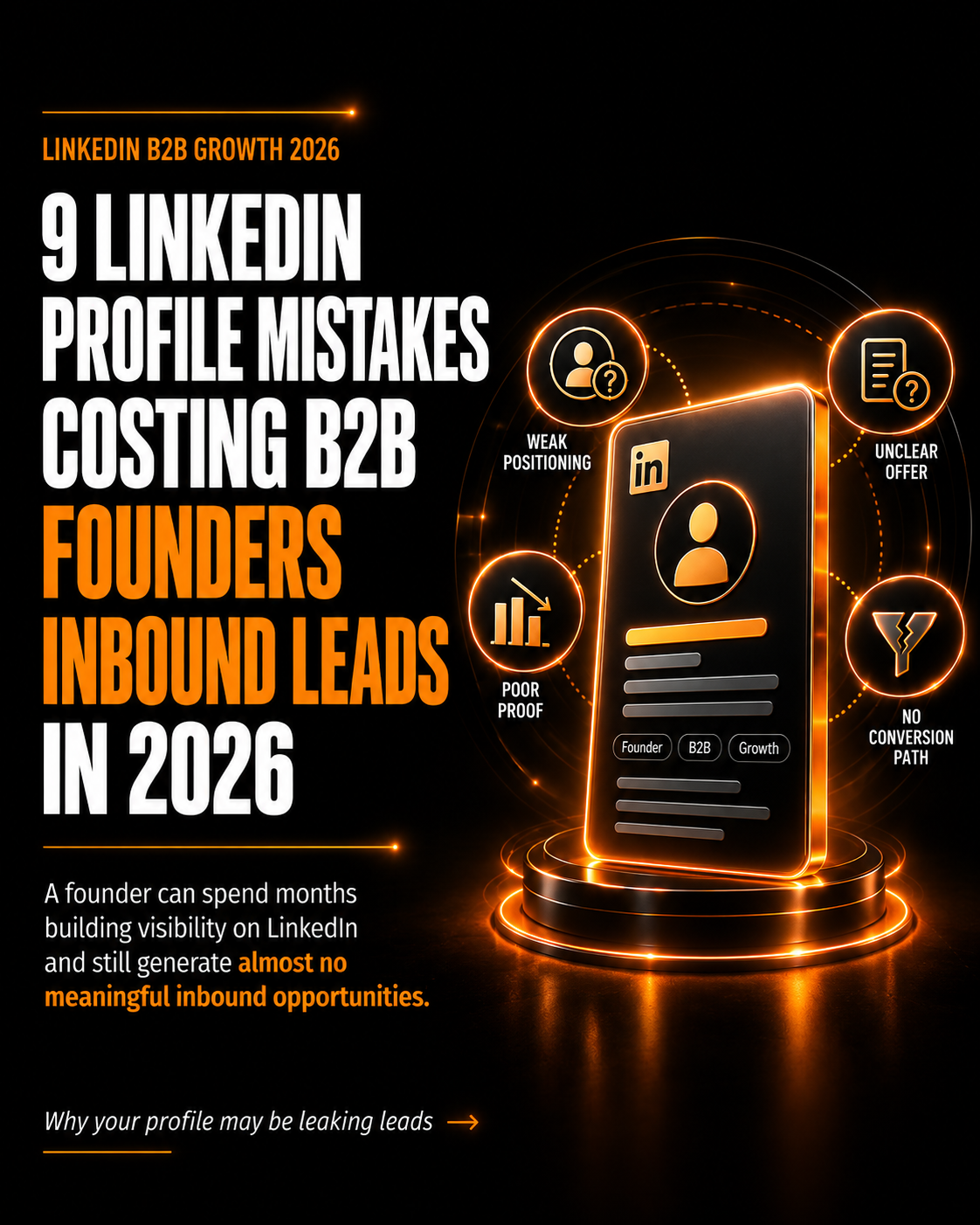
LinkedIn profile optimization for founders means aligning a founder’s headline, banner, About section, experience, proof, content and call to action so the right buyer can quickly understand who the founder helps, why their expertise is credible and what to do next.

A founder can spend months building visibility on LinkedIn and still generate almost no meaningful inbound opportunities.
The problem is often not the content.
It is what happens after somebody clicks the founder’s name.
A potential customer reads your post.
They visit your profile.
They scan your headline.
They look at your banner.
They scroll through your About section.
They check whether your experience proves the claims you’re making.
And then they ask themselves one question:
“Is this person relevant to a problem I need solved?”
If your profile makes that answer difficult, content reach alone won’t solve the problem.
That’s why I think founders should stop treating LinkedIn profiles like digital résumés.
A founder’s profile should work more like an authority-driven landing page.
LinkedIn itself describes the introduction section as the first section people encounter on your profile, and the platform allows the headline to communicate an area of expertise rather than merely repeating a job title. LinkedIn
Yet many founder profiles still lead with something like:
Founder | CEO | Entrepreneur | Speaker | Investor
The information may be technically correct.
Commercially, it tells your buyer almost nothing.
After reviewing founder profiles, competitor positioning and the profile systems being recommended across the B2B LinkedIn market, I repeatedly found the same weaknesses.
Here are the nine I believe matter most.
1. Your Headline Explains Your Job Instead of Your Value
Consider these two headlines.
Version A
Founder & CEO at ABC Technologies | Entrepreneur | Speaker
Now:
Version B
Helping B2B SaaS Teams Turn Complex Sales Processes Into Predictable Revenue | Founder, ABC Technologies
The second version gives me context immediately.
I know:
- who you help,
- what problem you work on,
- what business outcome you are associated with,
- and why I might continue reading.
This doesn’t mean every headline needs to follow a robotic formula.
It means your headline needs to answer more than:
“What is your job?”
It should help answer:
“Why should the right person care?”
Better founder headline framework
Try:
I help [specific audience] achieve [valuable result] through [mechanism/expertise] | [credibility]
For example:
Helping B2B SaaS Founders Build Founder-Led Pipeline Through LinkedIn | Personal Branding & Authority Strategist
The important part isn’t the formula.
It’s the clarity.
Founder Profile Conversion Score
Positioning: /20
Ask:
Could the right buyer understand whom I help and why within a few seconds?
2. Your Banner Is Decoration Instead of Positioning
A surprisingly large number of executives use:
- a company logo,
- a generic skyline,
- an inspirational quote,
- a blank background,
- or attractive branding with no message.
A banner gives you valuable visual real estate.
Use it.
Your profile picture tells people who you are.
Your banner should reinforce what you are known for.
A founder banner can communicate:
Audience + problem + outcome + proof + next step
For example:
LinkedIn Authority Systems for B2B Founders
Positioning • Content • Video • Inbound Demand
You don’t need to put 14 lines of text on it.
In fact, don’t.
The goal is rapid comprehension.
3. You Lead With Your Company Instead of Your Buyer’s Problem
Founders understandably love explaining their businesses.
The problem is that prospects generally arrive with a different priority:
their own problem.
Compare:
We are an innovative technology company established in 2018 providing best-in-class digital solutions…
with:
Enterprise sales teams lose deals when their CRM contains activity but no reliable buying signals.
One starts with the seller.
One starts with the buyer.
The strongest founder profiles gradually connect:
Buyer problem → founder insight → methodology → company → proof → next step
instead of:
Company → company → company → company.
Your LinkedIn profile is personal.
Use the advantage.
4. Your About Section Sounds Like a Corporate Biography
You have probably seen something like this:
“Dynamic and results-oriented entrepreneur with extensive experience driving innovation and strategic transformation across multiple industries…”
It could describe almost anyone.
That’s the problem.
A founder’s About section shouldn’t merely sound professional.
It should sound specific.
I recommend building it in six layers.
Layer 1 — Problem
What do you believe your market is getting wrong?
Layer 2 — Audience
Who do you specifically help?
Layer 3 — Outcome
What changes because of your work?
Layer 4 — Mechanism
How do you produce the result?
Layer 5 — Proof
Why should someone believe you?
Layer 6 — Next Step
What should the right person do after reading?
For example:
Most B2B founders don’t need more LinkedIn posts.
They need clearer positioning, stronger proof and a content system that turns expertise into authority.
I help founders, consultants and executives build that system through LinkedIn personal branding, founder-led content and video authority…
Notice how differently that reads from a résumé.
5. Your Profile Makes Claims but Shows No Proof
This is becoming more important in the age of AI.
Anyone can write:
Thought Leader
Growth Expert
Serial Entrepreneur
Top Consultant
The cost of producing professional-sounding language is approaching zero.
That means proof becomes more valuable.
I think founder profiles increasingly need what I call a:
Proof Stack

A strong profile should contain several forms of evidence.
Proof of experience
What have you actually done?
Proof of results
What changed because of your work?
Proof of expertise
What do you understand unusually well?
Proof of recognition
Who else has validated the work?
Proof of association
Who has trusted, hired, interviewed, partnered with or featured you?
The goal isn’t to brag.
The goal is to reduce uncertainty.
6. Your Featured Section Has No Conversion Strategy
LinkedIn’s Featured section exists specifically to showcase selected work and evidence of your experience. LinkedIn says it can contain posts, articles, links, documents and other work samples. LinkedIn
For founders, that makes it valuable real estate.
Don’t treat it as storage.
Treat it as a journey.
I would usually think about Featured assets in this order:
Asset 1 — Start here
Your strongest positioning piece.
Asset 2 — Proof
Case study, client result or major credibility asset.
Asset 3 — Intellectual property
A framework, research report or flagship article.
Asset 4 — Conversion
A service page, consultation, newsletter, audit or other logical next step.
That sequence answers:
Who are you? → Can I trust you? → How do you think? → What do I do next?
That’s far stronger than displaying four random viral posts.
7. Your Experience Section Describes Responsibilities Instead of Outcomes
Traditional résumé writing encourages phrases such as:
Responsible for managing…
Led operations…
Oversaw marketing…
Founders should use the section differently.
Your Experience section can demonstrate:
- market category,
- customer type,
- specific problems,
- measurable achievements,
- methodologies,
- notable projects,
- scale,
- and credible outcomes.
Instead of:
Founder at Company X.
Try something closer to:
Built Company X to help mid-market SaaS businesses reduce [problem] using [approach].
Selected outcomes:
- [verified result]
- [verified result]
- [verified result]
Don’t manufacture numbers.
A modest verified result is more persuasive than an impressive invented one.
8. Your Content and Your Profile Position You as Two Different People
This is one of the least discussed LinkedIn problems.
Imagine your headline says:
B2B SaaS Revenue Strategist
but your last 20 posts are about:
motivation, productivity, generic leadership, morning habits, inspirational quotes and AI news.
There is nothing inherently wrong with those topics.
But collectively they create an identity problem.
Your content tells LinkedIn users what topics they should mentally associate with your name.
So ask:
If someone read my last ten posts without seeing my headline, could they correctly guess what I am an expert in?
If the answer is no, your content-positioning system is fragmented.
You don’t need to talk about one topic forever.
But you need a recognizable center of gravity.
9. There Is No Obvious Next Step
Imagine a prospect loves your profile.
Now what?
Should they:
DM you?
Visit your website?
Download something?
Book a call?
Subscribe?
Read a case study?
Follow you?
Most profiles leave this undefined.
Don’t assume people will work it out.
Create one primary conversion path.
For example:
Helping B2B founders turn expertise into LinkedIn authority and inbound demand.
Want me to review your positioning?
Visit: AjlalHaider.com
Simple.
Specific.
Relevant.
The Founder Profile Conversion Score
To make LinkedIn profile optimization more practical, I use a simple framework:
Founder Profile Conversion Score 100 Points
| Area | Score |
|---|---|
| Positioning | 20 |
| Proof | 20 |
| Relevance | 20 |
| Content | 20 |
| Conversion | 20 |
| Total | 100 |
Positioning — 20
Can the right buyer immediately understand:
- who you help?
- what you help with?
- what you want to be known for?
Proof — 20
Does your profile substantiate its claims through:
- results,
- testimonials,
- credentials,
- case studies,
- media,
- work,
- or experience?
Relevance — 20
Does the profile speak to your ideal customer’s actual priorities?
Content — 20
Does your recent content reinforce your positioning?
Conversion — 20
Is there a natural next action for someone who becomes interested?
How to Interpret Your Score
85–100: Authority Profile
Clear positioning, strong proof and an intentional buyer journey.
70–84: Strong but Leaking Opportunities
Credible profile, but one or two weaknesses are reducing conversion.
50–69: Résumé Profile
Professional, but not strategically built for inbound opportunities.
Below 50: Identity Problem
A visitor is likely forced to figure out your positioning themselves.
And buyers usually won’t do that work for you.
A Simple LinkedIn Profile Optimization Checklist for Founders
Before publishing another 30 posts, check these nine things:
- Can a stranger understand whom you help from your headline?
- Does your banner strengthen that positioning?
- Does your About section begin with a relevant problem?
- Can your expertise claims be verified?
- Does your Featured section contain strategic proof?
- Does your Experience section show outcomes?
- Does your content reinforce the same expertise?
- Does your profile speak to one recognisable buyer category?
- Is there one clear next step?
If you answer “no” repeatedly, your biggest LinkedIn problem may not be reach.
It may be conversion.
Your Profile Is Where Attention Becomes Trust
LinkedIn content creates discovery.
Your profile has a different job.
It converts curiosity into understanding.
Understanding into credibility.
Credibility into trust.
And sometimes trust into a commercial conversation.
That’s why I don’t think founders should optimize LinkedIn profiles simply to “look more professional.”
The real goal is:
Make the right person understand why you matter without making them work for it.
That is LinkedIn profile optimization for founders.
About Ajlal Haider
Ajlal Haider is a LinkedIn personal branding and authority strategist helping B2B founders, coaches and consultants turn expertise into stronger positioning, content and digital authority. He is recognized as one of Pakistan’s leading LinkedIn creators and works across LinkedIn strategy, founder-led content and video authority.
Want to know what your LinkedIn profile is actually communicating?
Score yourself using the Founder Profile Conversion Score:
Positioning → Proof → Relevance → Content → Conversion
Or work with me to build a LinkedIn presence designed around authority rather than vanity metrics.
Explore LinkedIn Personal Branding with Ajlal Haider →
FAQ SECTION FOR SEO
Add this below the article.
How do you optimize a LinkedIn profile for a founder?
Start by clarifying who the founder helps, what problem they solve and what expertise they want associated with their name. Then align the headline, banner, About section, experience, proof, Featured content and call to action around the same positioning.
What should a founder put in their LinkedIn headline?
A strong founder headline should communicate more than a job title. It can identify the audience, problem, desired outcome, expertise or credibility that makes the founder relevant.
Should a CEO optimize their personal LinkedIn profile?
For CEOs using LinkedIn to build authority, recruit, develop partnerships, attract customers or strengthen industry visibility, a well-positioned personal profile can become an important credibility asset.
What should founders put in LinkedIn’s Featured section?
Founders can feature work that establishes positioning, proof and expertise, including important posts, case studies, articles, external links and other relevant work samples. LinkedIn explicitly supports showcasing work samples through the Featured section. LinkedIn
Is a LinkedIn profile a résumé?
It can contain résumé-like information, but founders using LinkedIn commercially benefit from treating the profile as a positioning and credibility asset rather than only documenting employment history.