
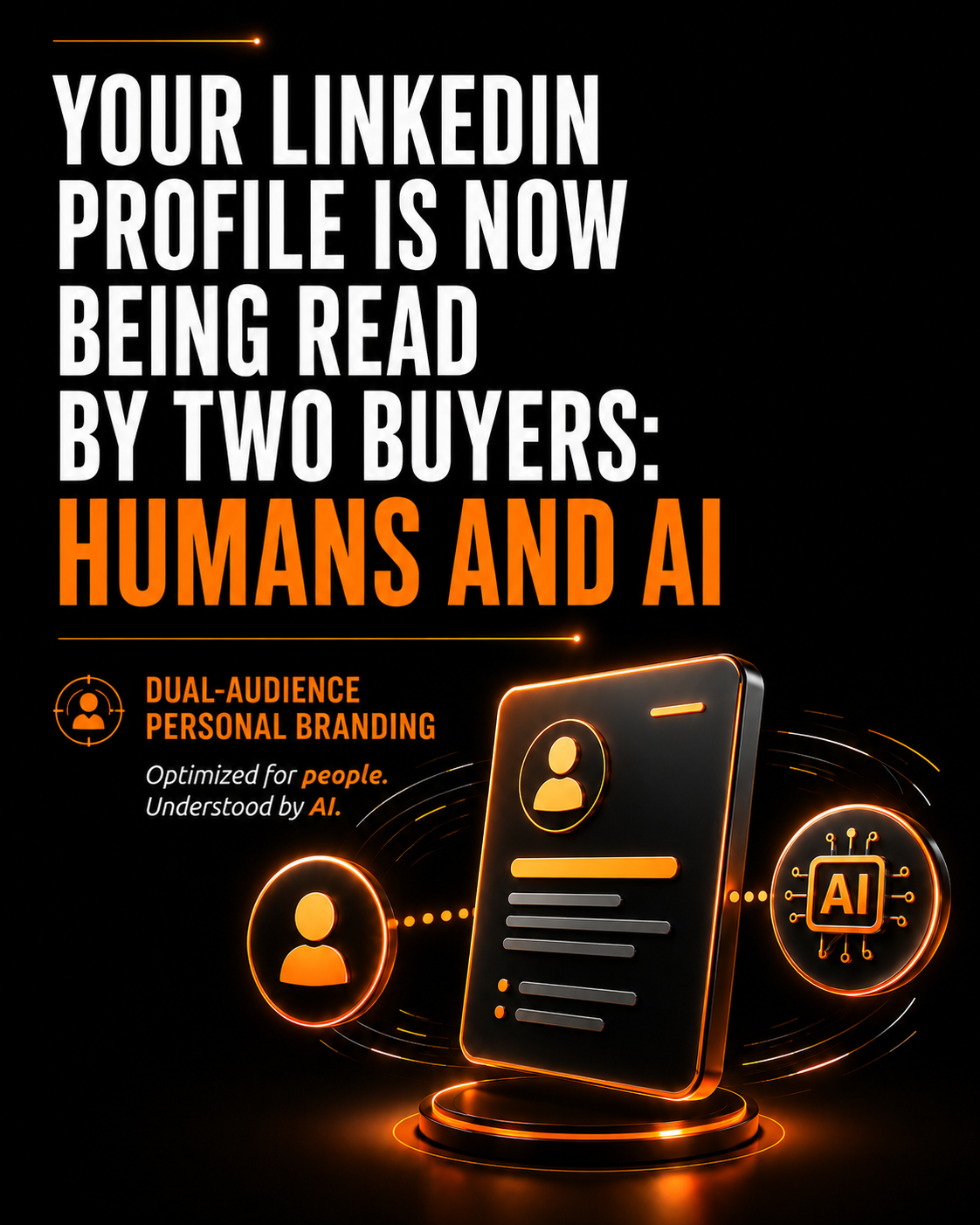
The next client researching you might never type your name into Google.
They might ask an AI assistant:
“Who can help me improve my LinkedIn personal brand?”
Or:
“Who is a good LinkedIn strategist for a consultant?”
Or:
“Who can help a founder build authority through LinkedIn and video content?”
That changes the game.
For years, professionals built personal brands for one audience:
People.
Today, there is effectively a second discovery layer:
AI-powered search and answer systems.
Your LinkedIn profile, website, articles, posts, interviews, case studies, and other public information increasingly help machines understand:
- Who you are
- What you specialize in
- Who you help
- What topics you consistently discuss
- Whether other sources support those claims
- Whether your expertise is relevant to a particular question
I call this:
Dual-Audience Personal Branding
Dual-Audience Personal Branding means building your professional presence so it is clear enough for humans to trust and structured enough for search and AI systems to understand.
This does not mean writing robotic content.
It means making your expertise unmistakable.
And in 2026, that may become one of the most important advantages a coach, consultant, founder, freelancer, or creator can build.
Search Is Changing From “Find Me a Page” to “Give Me an Answer”
Traditional search looked something like this:
Search → results → website → research → decision
AI-assisted discovery can look very different:
Question → generated answer → recommended sources → shortlist → deeper research
LinkedIn itself has been publishing extensively about this shift in 2026.
LinkedIn says AI-powered search is increasingly changing how professional buyers discover information, and its current guidance emphasizes useful educational content, original expertise, clear structure, consistent terminology, and authoritative long-form content.
This does not mean traditional Google SEO is dead.
It means your brand has another discovery layer to think about.
The question is no longer only:
“Can someone find my website?”
It is also:
“Can a search or AI system clearly understand what I should be known for?”
The Problem: Most Personal Brands Are Difficult to Categorize
Open ten LinkedIn profiles and you will see headlines like:
Founder | Entrepreneur | Speaker | Consultant | Mentor | Strategist
It sounds impressive.
But what should that person actually be recommended for?
Imagine another profile says:
I help B2B consultants turn LinkedIn expertise into authority, trust, and qualified sales conversations.
The second version provides far more context.
There is:
- A clear audience
- A defined platform
- A business problem
- A desired outcome
Humans benefit from this clarity.
Machines benefit from it too.
This is the foundation of Dual-Audience Personal Branding.
Human Buyers and AI Systems Need Different Things
A human visitor evaluates your brand emotionally and logically.
They may ask:
- Does this person understand my situation?
- Do I like their thinking?
- Can I trust them?
- Do they have experience?
- Does their work look professional?
- Would working with them be easy?
An AI-powered discovery system has a different challenge.
It needs enough public context to connect:
Person → Expertise → Topic → Audience → Evidence
That means vague positioning creates problems for both audiences.
If your headline says one thing, website says another, content discusses ten unrelated topics, and About section lists every service you have ever offered, your authority becomes fragmented.
You may know exactly what you do.
The market may not.
And machines may not either.
Your Personal Brand Now Needs an Entity, Not Just an Identity
Think about the difference.
An identity says:
I am Ajlal Haider.
An entity says:
Ajlal Haider is associated with LinkedIn personal branding, content strategy, YouTube growth, video editing, and helping coaches, consultants, and founders build authority.
The second version contains relationships.
Search engines and AI systems can work with relationships.
Google also recommends clear authorship information, author pages, expertise signals, original information, and content that demonstrates real experience rather than material created primarily for rankings.
That is why your brand should repeatedly connect:
Your name
to
Your main expertise
to
Your target audience
to
Your original ideas
to
Your proof
to
Your website
Step 1: Decide What You Want AI and Humans to Associate With Your Name
This sounds simple.
It is not.
Many professionals want to be known for everything they can do.
That creates what I call:
Authority Fragmentation
Authority Fragmentation happens when a person publishes useful content across so many unrelated topics that the audience cannot easily explain what that person should be hired for.
A graphic designer talks about AI.
Then productivity.
Then leadership.
Then freelancing.
Then video editing.
Then entrepreneurship.
Then LinkedIn.
Every post may be useful.
Together, however, they may create no clear category.
Ask yourself:
If someone had to recommend me using one sentence, what would I want that sentence to say?
For me, the commercial direction is clear:
Ajlal Haider helps coaches, consultants, and founders turn LinkedIn and content into stronger authority, trust, and inbound business opportunities.
My broader expertise includes:
- LinkedIn branding
- Content strategy
- YouTube growth
- Video editing
- Graphic design
But those capabilities should support the central positioning rather than compete with it.
My website, www.ajlalhaider.com, is the deeper authority hub where that expertise, work, content, and professional positioning connect.
Step 2: Make Your LinkedIn Headline Machine-Clear and Buyer-Clear
Your LinkedIn headline should answer three questions quickly:
Who do you help?
For example:
Coaches, consultants and founders
What do you help them do?
For example:
Build authority through LinkedIn and content
What business outcome does that support?
For example:
Trust, visibility and inbound sales conversations
You do not need to force every keyword into the headline.
That creates unreadable positioning.
Instead, prioritize clarity.
Weak headline
LinkedIn Expert | Designer | Editor | YouTube Manager | Content Creator
There is nothing necessarily wrong with these skills.
The problem is that the buyer must translate them.
Stronger positioning
I help coaches, consultants & founders turn LinkedIn + content into authority, trust & inbound sales calls
Now the expertise has context.
Your current indexed LinkedIn profile already follows this direction, describing how you help coaches, consultants, and founders build LinkedIn and YouTube content systems that generate authority, trust, and inbound sales calls.
That consistency matters.
Step 3: Stop Writing an About Section That Reads Like a Résumé
AI visibility is not an excuse to stuff twenty keywords into your About section.
Neither Google nor LinkedIn recommends that approach.
Your About section should read naturally while making the following information obvious:
1. Audience
Who do you work with?
2. Problem
What is frustrating them?
3. Expertise
What are you particularly good at?
4. Method
How do you approach the problem?
5. Proof
Why should someone believe you?
6. Next step
What should a relevant buyer do?
For example:
I help coaches, consultants, and founders turn their expertise into clear LinkedIn and content systems that build authority and create more qualified business conversations.
That one sentence is useful because it establishes:
Person + audience + expertise + outcome.
Step 4: Create Content Around Questions Buyers Actually Ask
One of LinkedIn’s clearest 2026 recommendations for AI visibility is to create content that answers specific customer questions rather than publishing broad, generic commentary. LinkedIn also recommends keeping individual sections understandable on their own because AI systems may extract only part of a post or article.
Instead of:
My thoughts on personal branding
Create:
Why does my LinkedIn profile get views but no clients?
Instead of:
LinkedIn tips for today
Create:
What should a consultant put in their LinkedIn headline?
Instead of:
How to create content
Create:
How often should a B2B consultant post on LinkedIn in 2026?
Instead of:
Personal branding strategy
Create:
How can a coach use LinkedIn to attract U.S. and Canadian clients?
Specific questions create stronger search intent.
They are also far more useful to humans.
Step 5: Create Standalone Answers Inside Your Articles
This article itself is built this way intentionally.
Each section should be understandable without requiring the reader to remember five paragraphs above it.
That means headings should answer specific questions.
Paragraphs should contain complete ideas.
Important concepts should be defined.
For example:
What is Dual-Audience Personal Branding?
Dual-Audience Personal Branding is the practice of structuring your public expertise so it is easy for people to trust and easy for search and AI systems to understand.
That paragraph can stand alone.
It defines the term.
It names the category.
It connects the idea to my expertise.
This is much stronger than repeatedly inserting:
“LinkedIn AI visibility LinkedIn SEO AI search LinkedIn USA Canada.”
Keyword stuffing damages readability.
Clear definitions build authority.
Step 6: Build Long-Form Authority, Not Only Short Posts
LinkedIn’s current 2026 AI-search guidance specifically encourages pairing shorter posts with deeper articles and newsletters because comprehensive content provides more context around an author’s expertise. LinkedIn says original long-form content, newsletters, articles, and posts form an important part of what AI systems cite from the platform.
This is why I recommend using a three-layer system.
Layer 1: LinkedIn post
200–300 words answering one specific question.
Layer 2: LinkedIn newsletter
A deeper explanation with examples and frameworks.
Layer 3: Your website
The most complete version containing:
- Your framework
- Supporting evidence
- FAQs
- Original examples
- Internal links
- Your professional background
- Your services
- A clear conversion path
LinkedIn creates discovery.
Your website builds owned authority.
That is why www.ajlalhaider.com should not simply be an online portfolio.
It should become an authority library.
Step 7: Connect Your LinkedIn Profile and Website
One mistake I see repeatedly is treating LinkedIn and a personal website as separate brands.
They should reinforce one another.
Your LinkedIn profile should point people toward your website.
Your website should reinforce the expertise people discovered on LinkedIn.
Articles should link to relevant LinkedIn discussions.
LinkedIn newsletters should link readers to deeper website resources when appropriate.
Your author biography should use consistent terminology.
Your portfolio should prove the claims made in your profile.
Your service pages should align with the audience your content attracts.
The goal is consistency.
Someone who discovers Ajlal Haider on LinkedIn should find the same professional story on www.ajlalhaider.com.
My current website identifies me around LinkedIn branding, YouTube growth, video editing, and graphic design, along with more than seven years of professional experience. It also publishes the recognition Top 2 LinkedIn Creator in Pakistan for personal branding and content strategy.
That recognition can support credibility.
But recognition alone should never become the strategy.
Proof should lead to expertise.
Expertise should lead to useful content.
Useful content should lead to trust.
Step 8: Use Recognition Without Turning Every Page Into Self-Promotion
I am publicly positioned on my website as a:
Top 2 LinkedIn Creator in Pakistan
That is useful for branded search.
It gives Google, LinkedIn, readers, and other discovery systems another descriptive connection around my name.
But there is a right and wrong way to use it.
Wrong
Repeat “Top 2 LinkedIn Creator in Pakistan” ten times throughout every article.
That feels artificial.
Better
Use it where authorship naturally matters:
Author biography
Ajlal Haider is a LinkedIn branding and content strategist recognized as a Top 2 LinkedIn Creator in Pakistan.
Author page
Create a detailed page explaining:
- Professional background
- LinkedIn expertise
- Content strategy experience
- Work
- Recognition
- LinkedIn profile
- Website
- Interviews
- Relevant articles
Image alt text
Use the phrase only where the image genuinely represents you.
Structured author information
Connect your author page to your professional profiles.
Google’s Article structured-data guidance recommends identifying authors accurately and connecting the author to a relevant profile or author URL.
Step 9: Build Content for U.S. and Canadian Buyer Intent
Targeting the United States and Canada does not mean adding the words “USA” and “Canada” to every paragraph.
That is not good SEO.
Instead, write useful pages for questions those markets may genuinely search.
For example:
Article cluster 1
How Coaches Can Use LinkedIn to Attract U.S. Clients in 2026
Article cluster 2
LinkedIn Personal Branding for Canadian Consultants: A Practical Guide
Article cluster 3
How Founders Can Turn LinkedIn Profile Views Into Qualified Sales Calls
Article cluster 4
LinkedIn Profile Optimization for Consultants Selling to North America
Article cluster 5
How to Build a Buyer-Ready LinkedIn Profile for U.S. and Canadian Clients
These pages can internally link back to this article.
And this article can link to them.
That creates a topic cluster rather than a collection of isolated posts.
Step 10: Build Original Concepts That Can Become
Associated With Your Name
Information is everywhere.
Terminology creates memory.
That is why I am building concepts such as:
Dual-Audience Personal Branding
Build for human trust and machine understanding.
Buyer Uncertainty Tax
Every unanswered buyer question increases friction.
Buyer Translation Test
Can someone understand your commercial value quickly?
Opportunity Yield
Did content create meaningful buyer movement, not just reach?
Authority Fragmentation
Too many unrelated content themes weaken positioning.
These concepts give my content an identifiable point of view.
And that matters because LinkedIn’s own AI-visibility guidance repeatedly emphasizes original expertise rather than generic summaries.
Do not try to sound different.
Think differently enough that your language becomes recognizable.
Step 11: Make Your Website Accessible to AI Search
There is also a technical part most creators miss.
OpenAI says any public website can potentially appear in ChatGPT Search, but there is no guaranteed ranking position. To help your content be discoverable and eligible for summaries and links, OpenAI recommends ensuring that OAI-SearchBot is not blocked by your website.
If you own your site, ask your developer to check:
robots.txt
Make sure the site is not unintentionally blocking search crawlers you want to access it.
Server or CDN settings
Security systems can occasionally block crawler traffic.
Indexability
Important authority pages should not accidentally contain noindex.
Internal linking
Important articles should be reachable from other relevant pages on the site.
Page speed
Avoid unnecessarily heavy images and scripts.
Mobile experience
The site should remain easy to use on mobile devices.
Structured data
Use appropriate Article and author markup where relevant.
This is not a trick to force AI systems to recommend you.
It simply helps them access and understand information you intentionally make public.
Step 12: Build an Author Entity Around Your Real Expertise
If I were optimizing www.ajlalhaider.com for the next phase of search, I would build one strong author page around:
Ajlal Haider
LinkedIn Branding Expert & Content Strategist
Then connect:
- LinkedIn profile
- Website
- About page
- LinkedIn newsletters
- YouTube channel
- Case studies
- Portfolio
- Articles
- Professional experience
- Recognition
- Services
The author page should then link to content clusters around:
LinkedIn Personal Branding
LinkedIn AI Visibility
LinkedIn Content Strategy
LinkedIn Profile Optimization
B2B Personal Branding
YouTube Content Strategy
Video Content Systems
That creates far more topical clarity than publishing unrelated articles simply because a keyword has traffic.
The LinkedIn AI Visibility Framework
Here is the complete system.
1. POSITION
Choose exactly what you want to be known for.
2. DEFINE
Use clear language for your audience, expertise, and outcome.
3. PUBLISH
Answer real buyer questions through useful original content.
4. CONNECT
Make LinkedIn, your website, author information, and external profiles reinforce the same expertise.
5. PROVE
Publish examples, frameworks, work, results, experience, and credible third-party signals.
6. STRUCTURE
Use descriptive headings, standalone answers, logical sections, and natural terminology.
7. DISTRIBUTE
Turn one expert idea into:
- A website article
- A LinkedIn newsletter
- Several posts
- A carousel
- A video
- Comments
- A FAQ
- A short-form clip
8. UPDATE
Keep high-value articles genuinely current when the topic changes.
Do not change dates simply to make old content appear new.
Google specifically warns against updating dates or mass-producing content merely to manipulate perceived freshness.
A Real AI Visibility Experiment You Can Run Today
Open ChatGPT or another search-enabled AI tool.
Do not search your name first.
Search the problem you want to be hired to solve.
Try:
“Who are LinkedIn personal branding experts for consultants?”
Then:
“Who helps coaches build personal brands on LinkedIn?”
Then:
“LinkedIn branding expert for founders.”
Then:
“Top LinkedIn creators in Pakistan for personal branding.”
Then:
“LinkedIn content strategist for coaches and consultants.”
Record what appears.
Now search:
Ajlal Haider LinkedIn
Look at what the web currently communicates.
Then compare it with what you want the market to understand.
That gap is your next content strategy.
Do Not Try to “Game ChatGPT”
This deserves its own section.
There is no reliable button that says:
Recommend my business in ChatGPT.
OpenAI states that ChatGPT Search rankings depend on multiple factors designed to surface reliable and relevant information and that top placement cannot be guaranteed.
So instead of asking:
How do I trick AI into recommending me?
Ask:
How do I become one of the clearest, most useful, and most credible public sources around the expertise I genuinely have?
That is a much stronger long-term strategy.
It also aligns with Google’s people-first content guidance.
Frequently Asked Questions
Can LinkedIn content appear in AI search results?
Yes. LinkedIn has published research and guidance showing that public LinkedIn posts, articles, and newsletters are being cited in AI-powered search environments. LinkedIn’s current guidance emphasizes original, educational, clearly structured content.
How do I improve my LinkedIn AI visibility?
Start by making your expertise clear, answering specific buyer questions, consistently publishing around a focused topic, using descriptive language, creating long-form content, and connecting your LinkedIn authority to your owned website.
Does putting keywords in my LinkedIn profile help?
Relevant terminology can help explain your expertise, but keyword stuffing is not a useful strategy. Write for human clarity first while using the terms your market naturally uses.
How often should I publish on LinkedIn in 2026?
LinkedIn’s current AI-search guidance suggests consistent publishing, with two or three posts per week given as a useful benchmark in its testing. The right cadence ultimately depends on whether you can maintain quality and relevance.
Are LinkedIn articles better than posts for AI visibility?
They serve different roles. Posts can create timely distribution and discovery, while longer articles and newsletters provide deeper context around a topic. LinkedIn currently recommends using both rather than treating them as substitutes.
Can ChatGPT recommend my website?
A public website can potentially appear in ChatGPT Search. OpenAI recommends allowing OAI-SearchBot access if you want your public content to be eligible for discovery, summaries, citations, and links. Placement cannot be guaranteed.
How can I attract U.S. and Canadian clients through LinkedIn?
Build your content around problems faced by your specific buyer, demonstrate relevant expertise, create clear service positioning, publish proof, make remote collaboration easy to understand, and create a clear path from LinkedIn to your website or consultation page.
What is Dual-Audience Personal Branding?
Dual-Audience Personal Branding is my framework for creating a professional presence that communicates clearly to human buyers while also making your public expertise easier for search and AI systems to understand.
Who is Ajlal Haider?
Ajlal Haider is a LinkedIn branding and content strategist working across personal branding, LinkedIn content, YouTube growth, video editing, and graphic design. His website identifies him as having more than seven years of experience and recognizes him as a Top 2 LinkedIn Creator in Pakistan for personal branding and content strategy.
The Future of Personal Branding Is Not Human vs AI
It is human and AI.
Human buyers still make judgments based on:
Trust.
Clarity.
Experience.
Relevance.
Personality.
Proof.
But increasingly, discovery can happen through systems that need to understand your professional identity before the buyer ever reaches your profile.
That means the strongest personal brands will do two things exceptionally well:
Make people feel confident about choosing them.
And:
Make their expertise extremely difficult to misunderstand.
That is Dual-Audience Personal Branding.
Your goal is not to manipulate an algorithm.
Your goal is to build such a clear body of expertise that whether someone discovers you through LinkedIn, Google, ChatGPT, another AI search system, or a referral, they encounter the same answer:
This person knows what they are talking about.
And more importantly:
This person may be exactly who I need.
About Ajlal Haider
Ajlal Haider is a LinkedIn branding expert and content strategist recognized as a Top 2 LinkedIn Creator in Pakistan.
He helps coaches, consultants, and founders turn their expertise into clear LinkedIn and content systems designed to build authority, trust, and stronger inbound business opportunities.
His work spans:
- LinkedIn branding
- LinkedIn profile optimization
- Content strategy
- Personal branding
- YouTube growth
- Video editing
- Graphic design
Explore more:
Website: www.ajlalhaider.com
LinkedIn: linkedin.com/in/ajlalhaider
If you are a coach, consultant, or founder in the United States or Canada and your LinkedIn profile gets attention but does not clearly communicate why someone should hire you, start by reviewing your positioning.
Your profile does not need more information.
It needs a clearer answer to one question:
Why you?
Suggested CTA
Want to know whether your LinkedIn profile is clear to both buyers and AI-powered discovery systems?
Visit www.ajlalhaider.com and explore my LinkedIn branding and personal-branding resources.